
How to integrate Visual Guard in WCF applications
To integrate Visual Guard in your WCF project you have to:
- Add the assemblies of Visual Guard as references of your project.
- Modify the "web.config" or the "app.config" file of your application to integrate the Visual Guard module.
- Integrate Visual Guard in the code of your application.
- Create a Visual Guard repository and declare your application by using the Visual Guard console. This repository will contain all security items (users, roles, permissions ...) of your application.
- Generate the Visual Guard configuration files by using the Visual Guard console. These configuration files will be needed to connect your application to the repository.
- Grant read/write permissions to the repository.
Referencing Visual Guard assemblies
In order to use Visual Guard, you must add references to Visual Guard assemblies
- Open the solution of your project in Visual Studio.
- In the solution explorer, expand the project node.
- Right-click the Project node for the project and select Add Reference from the shortcut menu.
- In .Net tab, select the 3 assemblies Novalys.VisualGuard.Security,
Novalys.VisualGuard.Security.WebForm,
Novalys.VisualGuard.Security.<RepositoryType> (File, SQLServer or Oracle). Click the Select button, and then click the OK button
Note: In the list of assemblies, Visual Studio can display different versions of the Visual Guard assemblies. You must select the assembly corresponding to the version of the framework used in your project
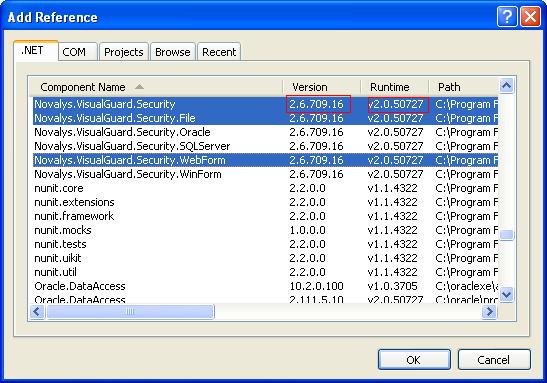
If the assemblies do not appear in this list you can use the Browse tab and select them in the directory <Visual Guard installation directory>/bin/2.0.
Description of Visual Guard assemblies
- Novalys.VisualGuard.Security contains the main Visual Guard classes.
- Novalys.VisualGuard.Security.Files contains the classes needed to access a file based repository.
- Novalys.VisualGuard.Security.SQLServer contains the classes needed to access a repository stored in a Microsoft SQLServer database (SQLServer 2000 or higher). Available only in Visual Guard Enterprise Edition
- Novalys.VisualGuard.Security.Oracle contains the classes needed to access a repository stored in an Oracle database (8i or higher). Available only in Visual Guard Enterprise Edition
- Novalys.VisualGuard.Security.WebService contains the classes needed for application hosting WCF services. You must reference this assembly in all project hosting WCF services that need to be secured by Visual Guard.
Modifying the "app.config" or "web.config" file of your application
To enable Visual Guard in your application, you must declare and configure the section class <system.serviceModel> of your application hosting your WCF services. You can edit your application configuration file manually or use the Microsoft Service Configuration Editor (Right-click on your configuration file then select the option 'Edit WCF Configuration) .
Adding a new service behavior
The first step is to create a new service behavior. This behavior allows you to indicate how Visual Guard authenticates and authorizes a client to access a service.
In Service Configuration Editor:
- Right-click on the 'Advanced>Service Behaviors' node in the tree view.
- Select the option 'New Service Behavior Configuration'.
- Change the name of the behavior (eg: VGSecurityBehavior).
<configuration>

     <system.serviceModel>

              ...

        <behaviors>

           <serviceBehaviors>

              <behavior name="VGSecurityBehavior">

              ...

              </behavior>

           </serviceBehaviors>

              ...

        </behaviors>

     </system.serviceModel>

  </configuration>
Now, you have to add serviceCredentials and serviceAuthorization elements to the service behavior
In Service Configuration Editor:
- Right-click on the service behavior node in the tree view.
- Select the option 'Add Behavior Element Extension'.
- Select serviceCredentials and serviceAuthorization elements then click ok.
In text editor:
<configuration>

     <system.serviceModel>

        <behaviors>

           <serviceBehaviors>

           <behavior name="VGSecurityBehavior">

                       <serviceCredentials>

                       ...

                       </serviceCredentials>

                       <serviceAuthorization>

              ...

                       </serviceAuthorization>

                 </behavior>

              </serviceBehaviors>

        </behaviors>

     </system.serviceModel>

  </configuration>
The serviceCredentials element specifies the credential to be used in authenticating the service and the client credential validation-related settings.
If you use Username/Password credentials to validate a Visual Guard account, you have to specify that the UserNamePasswordValidationMode is 'Custom' and the type of the CustomUserNamePasswordValidatorType is:
'Novalys.VisualGuard.Security.WebService.VGUserNameValidator, Novalys.VisualGuard.Security.WebService'.
In Service Configuration Editor
- Change the value of UserNamePasswordValidationMode to Custom.
- Change the value of CustomUserNamePasswordValidatorType to
'Novalys.VisualGuard.Security.WebService.VGUserNameValidator,Novalys.VisualGuard.Security.WebService'
In text editor:
<configuration>

     <system.serviceModel>

        <behaviors>

           <serviceBehaviors>

              <behavior name="VGSecurityBehavior">

                 <serviceCredentials>

                    <usernameAuthentication

                     userNamePasswordValidationMode="Custom"


  customUserNamePasswordValidator="Novalys.VisualGuard.Security.WebService.VGUserNameValidator,
    Novalys.VisualGuard.Security.WebService"

                    cachedLogonTokens="true"

                    />

                 </serviceCredentials>

              <serviceAuthorization>

              ...

              </serviceAuthorization>

           </behavior>


           </serviceBehaviors>

        </behaviors>

     </system.serviceModel>

  </configuration>
You can use your own authentication mechanism or any authentication mechanisms
compatible with WCF (Windows account...) . In this case, you can edit
your own configuration for the serviceCredentials element.
Visual Guard will use the identity provided by WCF to check the access
to the service.
Now you have to specify that the authorization access checking is provided
by Visual Guard. To do that, you must specify in the serviceAuthorization element that the PrincipalPermissionMode is 'Custom' and the ServiceAuthorizationManagerType is
'Novalys.VisualGuard.Security.WebService.VGServiceAuthorizationManager,Novalys.VisualGuard.Security.WebService'
In Service Configuration Editor
- Select the serviceAuthorization node in the tree view.
- Change the value of PrincipalPermissionMode to 'Custom'.
- Change the value of ServiceAuthorizationManagerType to:
'Novalys.VisualGuard.Security.WebService.VGServiceAuthorizationManager,Novalys.VisualGuard.Security.WebService'.
In text editor:
<configuration>

    <system.serviceModel>

      <behaviors>

        <serviceBehaviors>

          <behavior name="VGSecurityBehavior">

            <serviceCredentials>

              <usernameAuthentication

                  userNamePasswordValidationMode="Custom"


  customUserNamePasswordValidator="Novalys.VisualGuard.Security.WebService.VGUserNameValidator,Novalys.VisualGuard.Security.WebService"

                  cachedLogonTokens="true"
  />

            </serviceCredentials>

          <serviceAuthorization

              principalPermissionMode="Custom" serviceAuthorizationManagerType="Novalys.VisualGuard.Security.WebService.VGServiceAuthorizationManager,

                          Novalys.VisualGuard.Security.WebService"
  />

          </behavior>

        </serviceBehaviors>

      </behaviors>

    </system.serviceModel>

  </configuration>
The Visual Guard Service authorization manager will check the authorization access of the current identity. When the current identity is not allowed to access the application (when the user account is not defined in the repository or is not a member of a role of the application), Visual Guard will reject the access to the service if anonymous sessions are not allowed. When anonymous sessions are allowed, the caller is authorized to access the service and becomes a member of the Anonymous role.
Configuring the service
You have to specify the service behavior defined above to all services requiring Visual Guard authentication and authorization mechanism.
In Service Configuration Editor
- Select the node of the service to configure.
- Select the BehaviorConfiguration property in the right pane and select the service behavior defined above (eg:).
In text editor:
<configuration>

    <system.serviceModel>

      <services>

        <service behaviorConfiguration="VGSecurityBehavior" name="CalculatorService">

          <endpoint binding="wsHttpBinding" contract="ICalculatorService"
  />

        </services>

      ....

    </system.serviceModel>

  </configuration>
Integrating Visual Guard in your code
The main class in Visual Guard is Novalys.VisualGuard.Security.VGSecurityManager.
This class provides the main access point for interacting with Visual
Guard. It allows you to set the security of your application object.
You have 3 types of code to integrate Visual Guard in your code:
- When you want to restrict the access of a service to a caller.
- When you want to apply security actions on a WebService, a custom class or custom control, you must call Visual Guard to set the security of this object.
- When you want to check if a user has a specific permission or a specific role, in which case you can use
Novalys.VisualGuard.Security.VGSecurityManager.Principal
Restricting the access to a service
Visual Guard is compatible with the standard PrincipalPermissionAttribute
class. This attribute will check whether a user is authenticated or is
a member of a role. Visual Guard also provides its own attribute: Novalys.VisualGuard.Security.VGPrincipalPermission.
This attribute is similar to the standard PrincipalPermissionAttribute
class and allows you to check a Visual Guard role or aVisual Guard permission
and does not requires
The following example demonstrates how to restrict access to the "Multiply"
operation to a caller with the permission "CanMultiply".
[C#]

  [VGPrincipalPermission(SecurityAction.Demand,
    Name="CanMultiply", Type=VGPermissionType.Permission)]

  public double Multiply(double n1, double n2)

  {

    return n1 * n2;

  }


  [Visual Basic]

  <VGPrincipalPermission(SecurityAction.Demand,
    Name:="CanMultiply", Type=VGPermissionType.Permission)>
  _

  Public Function Multiply(Double n1, Double
    n2) As Double

      Return n1 * n2

  End Function
Securing application objects
If you need to apply Visual Guard security actions on an object of your application, you will need to call Visual Guard to set the security of the object. To do that, you must:
- Add the Novalys.VisualGuard.Security.VGISecurable interface to your class.
- Add the call to the VGSecurityManager.SetSecurity method at the end of the constructor.
If you want to understand how Visual Guard applies security to your application
objects, see How Visual Guard secures an application.
The following code shows how to secure the Calculator class that implements
the ICalculator service contract:
[C#]

  public class Calculator: ICalculator,
    VGISecurable

  {

                public
  Calculator()

                {

                              //
    ....

                      //
    Initialization of the object

                              //
    ....


                              //
    This call indicates to Visual Guard that the class must be secured.

                              VGSecurityManager.SetSecurity(this);

                }

                public
  double Multiply(double n1, double n2)

                {

                              return n1 * n2;

                }

  }
[Visual Basic]

  Public Class Calculator

          Implemenents ICalculator, VGISecurable

          Private
  Sub New()

                '
  ...

                '
  Initialization of the object

                '
  ...


                '
  This call indicates to Visual Guard that the class must be secured.


                VGSecurityManager.SetSecurity(Me)

                End
  Sub

          Public
  Function Multiply(ByVal n1 as Double, ByVal n2 as Double) As Double

                Return n1 * n2;

                End
  Function

  End Class
How to filter granted roles
If a user has more than one role, by default Visual Guard creates a permission set that will be a union of all permission sets granted to these roles. If you want to select only one role or filter roles granted to the user, you can handle the event VGSecurityManager.PermissionsLoading.
The following example demonstrates how to select the role Administrator if this role is granted:
[Visual Basic]

  Sub VGSecurityManager_PermissionLoading(ByVal sender As Object, ByVal e As VGPermissionsLoadingEventArgs)

    If e.Roles.Length > 1 Then

      Dim selectedRoles(1) As Novalys.VisualGuard.Security.VGGrantedRole

      For Each role As Novalys.VisualGuard.Security.VGGrantedRole In e.Roles

        If role.Name
    = "Administrator" Then

          selectedRoles(0) = role

          Exit
    For

        Else

          If role.Name = "Member" Then

            selectedRoles(0)
    = role

            Exit
    For

          End
    If

        End If

      Next

      If selectedRoles(0)
    Is Nothing Then

        e.Status = Novalys.VisualGuard.Security.VGAuthorizationStatus.ProcessCanceled

      Else

        e.Roles = selectedRoles

      End If

    End If

  End Sub
[C#]

  void VGSecurityManager_PermissionLoading(object sender, VGPermissionsLoadingEventArgs args)

  {

     if (e.Roles.Length > 1)

     {

       Novalys.VisualGuard.Security.VGGrantedRole[]
    selectedRoles = new Novalys.VisualGuard.Security.VGGrantedRole[1];

       foreach (Novalys.VisualGuard.Security.VGGrantedRole
    role in e.Roles)

       {

       if (role.Name
    == "Administrator")

       {

        selectedRoles[0]
    = role;

        break;

       }

       else if (role.Name
    == "Member")

       {

        selectedRoles[0]
    = role;

        break;

       }

      }

      if (selectedRoles[0]
    == null)

      {

       e.Status = Novalys.VisualGuard.Security.VGAuthorizationStatus.ProcessCanceled;

      }

      else

      {

       e.Roles = selectedRoles;

      }

    }

  }
How to change default Visual Guard configuration settings
By default, Visual Guard uses the Visual Guard configuration files located in the same directory as the Novalys.VisualGuard.Security.dll assemblies. It is possible to change the path of the configuration file or configuration at runtime by handling the event VGServiceRuntimeProvider.RuntimeInitialized.
Creating a repository and declaring the application
Once Visual Guard is integrated in your application, you can create the
repository containing the information about the security of your application
(users, roles, permissions ...). You must launch the Visual Guard console,
right-click the root node in the treeview then select the option "Add
repository".
After creating the repository, you must declare your application in the
repository. Right-click the node corresponding to your repository then
select the option "Connect...". After the connection,
right-click on the repository node then select the option "Add
application". At the end of the wizard, the console will
generate 2 configuration files in the directory containing the assemblies
of your application.
Note: If you want to test the connection to this repository
from your application, you will need to create a role for your application
in the Visual Guard console and grant this role to a user. A user defined
in the repository can access your application only when a role of the
application is granted to this user.
Granting Read/Write permission to the Repository
Visual Guard needs to grant Read/Write permissions to access the repository.
For example, for a file based repository you must grant "Modify"
permission to the directory containing the repository for ASP.NET user
accounts. For a repository stored in a database, the user used to access
the Visual Guard repository database must be a member of "vg_BasicAccess"
role.
In most cases, you must grant this permission to a "MACHINE\ASPNET"
user account. If you use IIS 6.0 on Windows Server 2003 the user account
is "NT Authority\Network Service". If you use impersonation,
you must grant permission to "MACHINE\IUSR_<MACHINE>"
for Form authentication mode and "Domain\UserName" for Windows
integrated authentication mode.
To change permission to a directory, you must:
- Open the Explorer.
- Right click the directory containing the repository data then select the menu "Properties".
- In the "Security" tab, click on the "Add" button and select the user for which you want to grant the permission (i.e. MACHINE\ASPNET) then click OK.
- In the list of permissions, click the option "Modify"
then click on the OK button.
See Also
Debugging
Visual Guard Security Actions
How
to apply security in your application
How
Visual Guard secures an application
How to generate or edit the Visual Guard configuration files